Rajasthan Budget Trip also offers to our customers Book your Hotel Accommodation in Rajasthan India, Car Transportation or Car Rental services in all over Rajasthan India, Flight /Train Ticket bookings, Jungle safaris, Camel safaris, Elephant Safari, Sariska & Ranthambore Jungle safari and many more services related Rajasthan vacations. We will offer a variety of Rajasthan Tour packages like Rajasthan Budget Tours, Golden Triangle Tours, Rajasthan Luxury Tours, Day Tours in Rajasthan Etc...
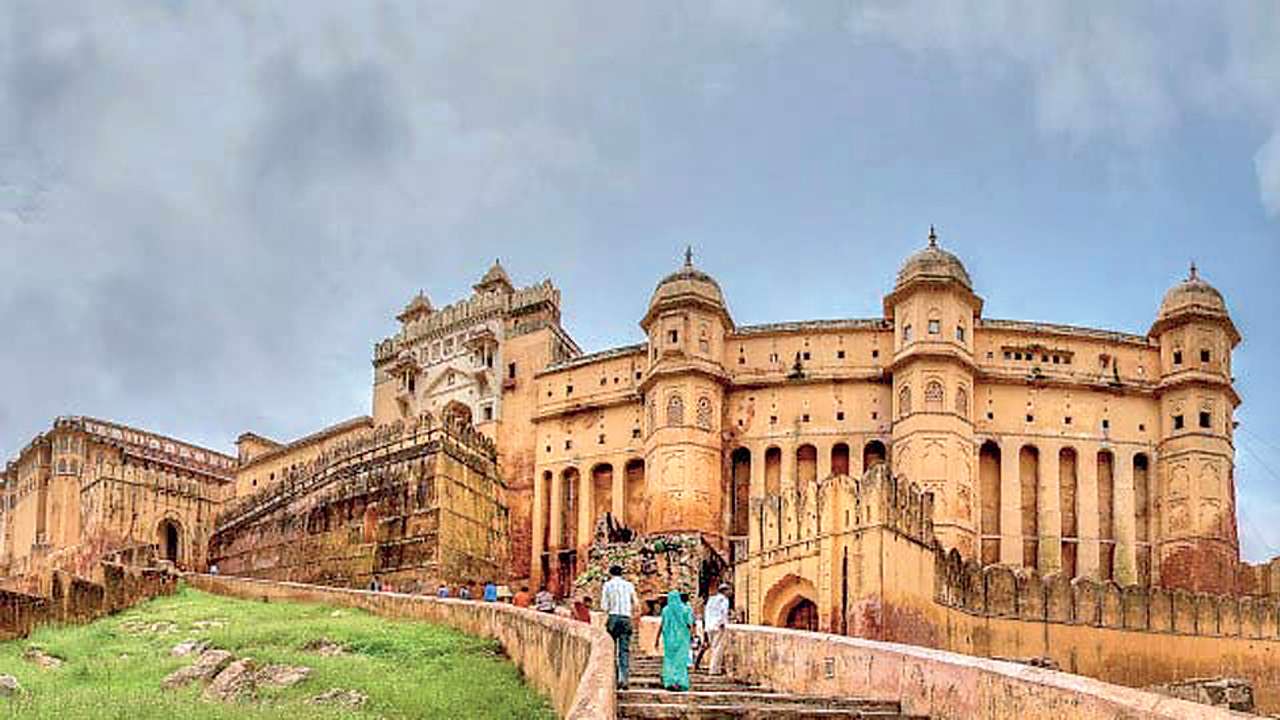
Amer Fort Jaipur is rated as one of the top things to do in Jaipur. It is a must-visit place in Jaipur. Recently, Amer Fort has been listed as one of the 17 iconic tourist sites identified by the Ministry Of Tourism of India. Amer Fort is a UNESCO World Heritage Site and is a part of the “Hill Forts of Rajasthan” cluster. People call it by many names like Amber Palace, Amer Ka Kila, Amber Fort, and so on. Even though it is commonly called a fort, in reality, it is a palace since it was a residential unit of the royal family.
What’s the History behind the Amer Fort : Amer was ruled by the Meena tribe before Kachwaha Rajputs took control. The capital of the Kachwaha ruler was Dausa near Jaipur. They were originally from Narwar before emigrating to this region. As per popular opinion, Kachwaha Rajputs befriended the Meenas and later massacred them to take control of Amer town.
Amer became the capital of the Dhundhad region ruled by Kacchawa Rajputs. The current building known as Amer fort was built by Raja Man Singh I in the 16th century. Many additions were made subsequently until it was abandoned in the early 18th century when the capital was shifted to Jaipur. The history of Amer Fort consists of a dark period when it was taken over by Mughals until it was recaptured by Maharaja Sawai Jai Singh II.
It takes 45 minutes to 90 minutes to complete a tour of Amer Fort. With so much to see and experience, this Amer Fort travel guide blog intends to help you plan your visit to the most popular fort in India. It intends to answer traveler’s common queries on the fort. I’m listing here what to see in Amer fort in the order of importance.
Architecture of Amer Fort : The Amer fort is built of red sandstone and marble. It is a perfect blend of the outlooks of the Rajput (Hindu) and Mughal (Islamic) architectures. It has a very grand layout comprising of royal courtyards, temples, palaces, gardens and chambers. This fort’s spectacular architecture will leave you completely spell bound by it’s beauty.
Jal Mahal (Water Palace) in Jaipur is a spectacular structure that seems to be floating on the lake’s surface. An architectural marvel in itself, it is an embodiment of the engineering prowess of the Rajput period. The palace, which was built as a hunting lodge for the Maharajas of Jaipur, has now become one of the prime tourist attractions in the city. While planning your trip, don’t forget to book your hotels in Jaipur such that you have easy access to this magnificent palace and other forts and historical attractions in the city.
Jal Mahal, Jaipur: History Jal Mahal, one of the top places to visit in Jaipur, doesn’t have any recorded history about who built it or when. However, it is popularly believed that Maharaja Sawai Pratap Singh constructed Jal Mahal in 1799 to serve as a hunting lodge during his duck shooting trips. Some people also credit Maharaja Madho Singh I for the construction of this palace and date its origins back to the 1750s. Regardless of who built the palace, it was never meant to be used as a regular palace for living.
Later, the palace was renovated by Maharaja Jai Singh II of Amber in the 18th century. Over the years, the structure suffered subsidence due to partial seepage of lake water and waterlogging issues. After several years of deterioration and neglect, renovation works were carried out in the early part of the 21st century to restore the palace into its former glory. Though the palace and many of its features have been restored, its original terrace garden could not be salvaged. Plans are on to create a new terrace garden modeled on the rooftop garden of the famous Amer Palace in Jaipur.
Jal Mahal Architecture Jal Mahal stands in the middle of a lake that has a maximum depth of 15 feet and a minimum depth of 4.9 feet. It is a five-storied structure built in the Rajput style of architecture, with influences of the Mughal architectural style. While four of its stories remain under water, only the top story remains visible, giving you an impression that the palace is floating on the waters of the lake.
Jal Mahal has been constructed out of red sandstone. Four elaborate chhatris designed in octagonal shape adorn the four corners of the palace. A huge Bengal-style rectangular chhatri also exists on the roof of the palace. In its heyday, the terrace garden of Jal Mahal was decorated with arched passages.
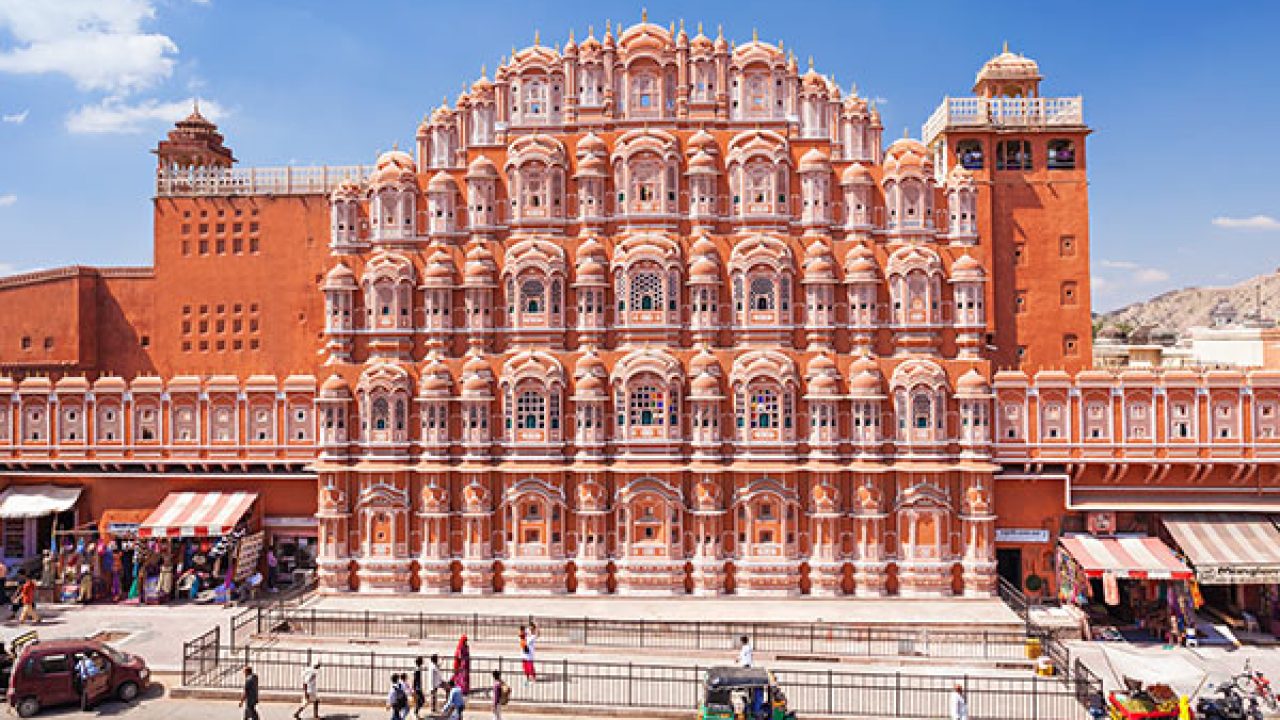
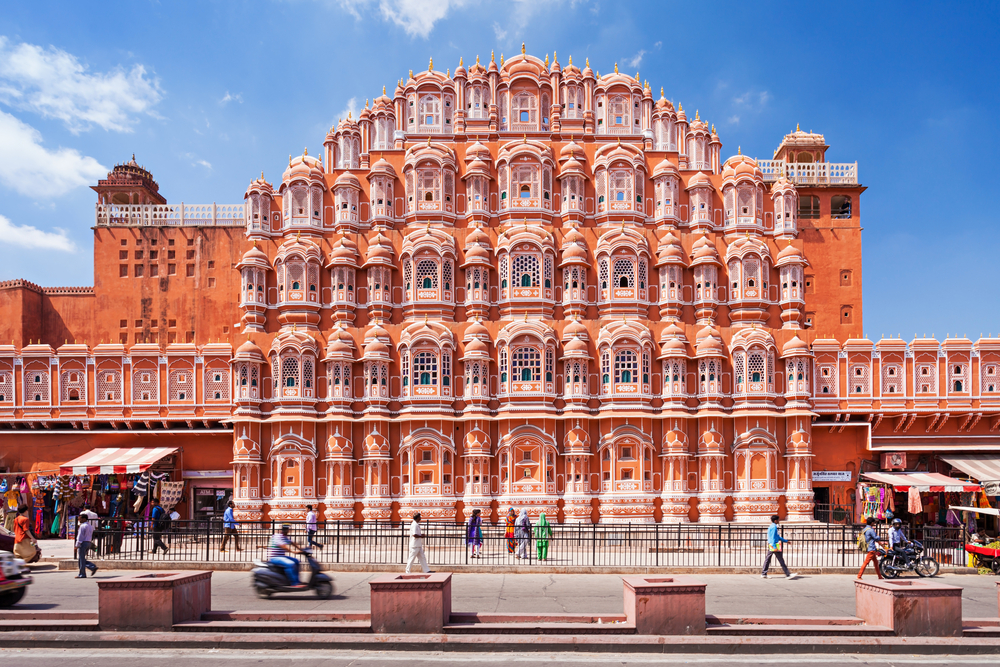
Hawa Mahal Jaipur Situated at Badi Choupad, Pink City of Jaipur, Hawa Mahal was built in 1799. It has 953 windows on the outside walls. The honeycomb shaped and beautifully carved windows allow breeze to blow through the palace and makes it a perfect summer palace. It was built as an extension to the City Palace nearby. See below for more information about Hawa Mahal.
Hawa Mahal: History Hawa Mahal was built by Kachhwaha Rajput ruler Maharaja Sawai Pratap Singh in the year 1799. When the maharaja saw the structure of Khetri Mahal in Jhunjhunu, Rajasthan, he was so impressed that he decided to build a palace modeled on it. Hawa Mahal, also called the Palace of Breeze, was the result of that inspiration.
This five-storied structure was designed by Lal Chand Ustad as an extension of the City Palace. Starting from the City Palace’s edge, Hawa Mahal extends to the women’s chambers aka zenana. During those days, the Purdah system was strictly followed and Royal Rajpur women weren’t allowed to show their face to strangers or even appear in public. The palace comprises 953 windows which enabled them to get a glimpse of the day-to-day activities and festivities happening on the street below without appearing in public.
Hawa Mahal, one of the best places to visit in Jaipur, features a splendid fusion of Islamic, Mughal, and Rajput architectural styles. Its domed canopies, floral patterns, lotus motifs, and fluted pillars, all reflect the rich Rajput style. Complementing these elements is the filigree work in stone and lavish arches, both of which draw influence from the Islamic style of architecture.
Designed in red and pink sandstone, this one-of-its-kind palace boasts of a pyramidal shape. It has five stories and rises up to a height of 50 feet. The 953 windows featured on the front part of the palace lend it a honeycombed hive look. Thanks to the exceptional latticework on these windows, the palace experiences a cooling effect as the breeze blows in through them. Delicately designed hanging cornices are another attractive aspect of Hawa Mahal’s architecture.
The interiors of the palace consist of pillared chambers and minimally ornamented corridors that reach up to the top floor. Patios adorn the front part of the first and second floors. Unlike the lower two floors, the top three floors have a width that’s not more than a single room. There are fountains adorning the center of the building’s courtyard.
A state that invites visitors with melodic tune of ‘Padhaaro Maare Desh’(Come to My Land), Rajasthan beckons the rich culture and history of India. Most of us recognize Rajasthan as a state of vibrant folk dance and music, gigantic forts and palaces, spicy food, colourful and large turbans, extensive golden sand desert, camels and the pride of Rajasthani men, Moochh (Moustache). Thus making it an incredible place to visit and enjoy unforgettable holidays. Sprawling in an area of 342239 sq km, Rajasthan. Thus, amalgamation of folk dance & music, golden sand desert, camels and the pride of Rajasthani men, colorful and large turbans make it an awesome place to visit and enjoy unforgettable vacations. Sprawl over an area of 342239 sq km, Rajasthan is crowned with the pride for North Indian state. The state is dotted with lot of tourist attractions which seems perfect holiday destination for visitors of all ages. In other words, we can properly say that a tour in Rajasthan is the complete bouquet for the vivid travelers.
Top 5 Fair Festivals in Rajasthan Even a quick stop at its capital city, Jaipur which is mirror of the state as it is flooded with majestic forts and palaces such as the Hawa Mahal, Jal Mahal, Amer Fort, lakes and monuments, architectural glories and has many other attractions like Chokhi Dhani that mesmerizes the tourists. The village tour of the royal state is an alternate way to enjoy the rustic beauty of the place. Even the air of majestic state sprays fragrance of cultural opulence everywhere. It is not just the architecture excellence of the city but here the world fame cities like Jaisalmer and Jodhpur are showcase of modern day artifacts too. One thing that pulls the attention of tourists while traveling through Rajasthan is the urban locality of the state that they are still closely associated with the old culture and tradition so that they can maintain the legacy of the past. The fairs and festivals that reflect the old traditions and rituals may surprise you at once. The world fame cattle fairs like Pushkar and Nagaur attracts lots of tourist. Beside this the most popular fairs and festivals are Mewar, Marwar, Teej, Elephant, Gangaur, Kite and many more that can be enjoyed round the year.
History : The glorious history of Rajasthan is about 5000 years old. The downfall of well established Gupta Empire marks the inception of Rajputana – a cluster of several Princely States of Rajasthan. The state faced many Muslim attacks but the courage and honor for the land kept Rajputs community strong. The era of evolution gave birth to the great leaders like Prithviraj Chauhan who defeated the invading Muhammad Ghori and Rana Pratap of Mewar who challenged the mighty Mughal Emperor Akbar.
However, the arrival of British East India Company in the region led to the administrative disintegration and during the 18th century, the Mughal Empire faced a major setback. Most of the Rajputana province continued with self-governance. The situation improved at the time of independence when Rajputana majorly comprised of 18 princely states joined hands with each other.
The year 1950 mark the merger of all 18 princely provinces into one united Sates of Rajasthan and Maharaja of Jaipur Sawai Man Singh II was elected as the Rajpramukh. Today Rajasthan has 33 districts.
Hot Air Ballooning is very popular in Jaipur that is the capital along with being the largest state in Rajasthan. There are a lot of architectural marvels which include forts, monuments, temples, palaces and so on which are frequently visited by tourists from all across the globe. Air balloon rides in Jaipur go on for an hour that is extremely adventurous. Hot air ballooning allows the tourists to take a glimpse of the whole city Jaipur , either in the morning or in the evening in the months from October to March from where the views are splendid on an aerial experience with a trained crew guiding you about the city from the skies throughout. The hot air balloon follows the direction of the wind, and is an amazing sight for the local villagers as well, nestled amidst the Aravali ranges.
Ideal for: Couples, Family, Groups, Tourists, Solo Explorers Where: Amber Fort, Jaipur When: All days of the week Duration: 1 hour Time slots (starting time): September, October and November: 6:15 am and 4:00 pm December, January, February and March: 6:45 am and 3:30 pm April, May and June: 5:45 am Safari Season Morning Flight Evening Flight Sep-Nov 6:15 am 4 pm Dec-March 6:45 am 3:30 pm April-June 5:45 am No Flights
The ‘Pink City’, is a step back in time. Be mesmerised as you drift slowly over the area surrounding the spectacular Amber Fort. Absorb the unique colours & sounds and as they blend beautifully with the historical Forts & hidden Palaces nestled amongst the Aravali Ranges. Capture a privillaged view of traditional Rajasthani villages and the smiles of friendly local people gazing up at you.
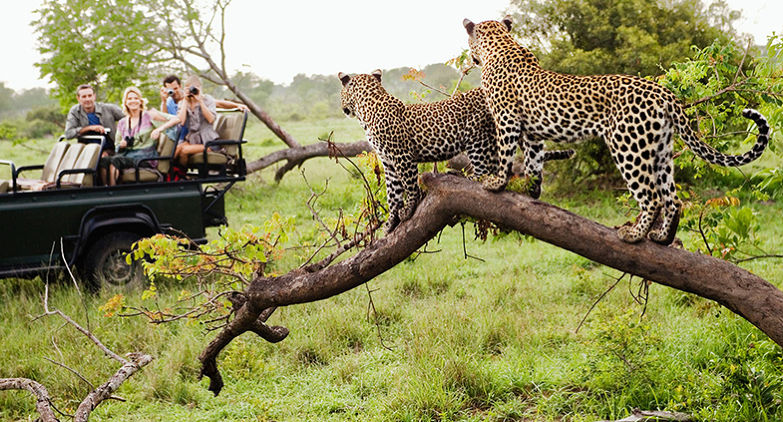
Jhalana Safari Park is a popular tourist attraction in Jaipur. The park is famous for birdwatching, but over the time, it has become quite a popular place to sight Indian leopards. Jhalana as the name suggests, offers the opportunity for exciting gypsy safari which is an excellent way to sight the wildlife in the park.
Apart from the leopards, there are a number of wild animals like hedgehog and desert fox that can be sighted. Along with the avifauna including Indian eagle owl and others, the park in the winter season becomes home to a large number of migratory birds like flamingos, cranes, egrets, dunlins, bar-headed goose and cormorants.
Jhalana Leopard Reserve is the 1st Leopard reserve in India Jhalana Leopard Conservation Reserve has more than 35 Leopards including 5 cubs. The last tiger was shot in 1948. Jhalana is spread over an area of 20. square kilometers. In 2017 Jhalana was identified as a Leopard Reserve by Rajasthan Forest Department. Jhalana was opened for the first time for tourists in December 2016.
The revised charges of jhalana Leopard Safari Half-Day Safari Rs 15000 for Indians and Rs 18000 for foreigners Gypsy Safari Rs 3500 for Indians and Rs 4500 for foreigners Tour guide charges Rs 1000 Desert Safari charges Rs 2000 for 6 person Camel Riding charges Rs 2000 for 2 person Night Safari charges Rs 5500 for 6 person ATV Bike Rides charges Rs 1500 for a single person Camping charges for AC tents Rs 3500 for 2 person
Best time to visit Jhalana Leopard Reserve: The Jhalana Leopard Reserve (The 1st Leopard reserve in India) is open for the safari tours for the visitors for all 12 months even in the monsoon season from 1st January to 31st December every year, according to the entry timings of that particular season. In Monsoon season most of the protected reserves in the country are closed, but here’s something to compensate for that.
Though one can enjoy the Jhalana Leopard Safari and savor the view of the majestic Leopard anytime, but from November to April is considered as the best time to visit Jhalana reserve as the weather is delightful at this point of time and nature is in its complete blossom around this time enhancing the beauty of the forest.
By Air: The Jaipur International airport is just 6 km away from Jhalana leopard reserve, which is approximately 15 minutes drive from the airport to Leopard Reserve. There are plenty of domestic and international flights connecting the pink city Jaipur to various cities of Indian and abroad. You can get a taxi, cab or Bus at Jaipur airport to reach Jhalana Safari Park.
By Rail:The Jaipur Junction Railway station is the nearest rail station to the Jhalana Leopard Reserve. Which is around 11.7 km away from the forest. The station is the famous tourist station and connected through the direct trains from the major cities of India like Udaipur, Delhi, Mumbai, etc. For covering the distance from the station to Jhalana, you can hire a taxi or catch the local bus.
By Road: There is a direct road passing nearby the Jhalana forest reserve connecting it with cities like Mumbai, Ahmedabad, Udaipur, Kota, etc which is further connected with the major cities of India. So, If you are choosing the direct road trip from Delhi, Mumbai, or Udaipur, you can easily reach the Jhalana without any hassle. You can get on the road trip in your own vehicle or opt for the state Bus services to reach Jhalana.
Top 5 Places to See in Khajuraho will still be a treat to your eyes with all its rock carvings and intricate designs. This is a destination where you can walk to unravel the mysteries of the bygone days, live in the cities of simple folk who speak less yet say a lot, and a place where you can be one with nature. Located in the state of Madhya Pradesh in India, with the backdrop of the Vindhya Mountain range Khajuraho is the perfect destination for people who love historical tales, appreciate art, and the serenity of nature. The mains sights here are the marvelous temples of the Hindus and Jain and describing the beauty of the rock carvings is no easy a feat.
As far as history goes these temples were constructed by the kings of the Chandela dynasty between the years 950 AD and 1050 AD. But after the fall of the ruler the temples were left unattended for several years until later to be found within a dense forest of palm trees, hence the town which was earlier known as Vasta, came to named Khajuraho. ‘Khajur’ is the word for date palm in Hindi. Sadly, out of 85 temples there are only 22 that survived the test of time. So, here are main attractions to see in Khajuraho, India:
Kandariya Mahadev Temple At a distance of 1 km from Khajuraho Bus Stand, the Kandariya Mahadev Temple is the most ornate Hindu temple in the medieval temple group found at Khajuraho in Madhya Pradesh, India. It is the largest and most beautiful temple in the Western Group of temples at Khajuraho.
Dedicated to Lord Shiva, the Kandariya Mahadev Temples was built by Vidyadhara, a powerful Chandela king. Its construction is dated to the period from 1025 and 1050 AD. Vidyadhara, also known as Bida, was a powerful ruler who fought Mahmud of Ghazni in 1019 AD. This battle was not conclusive and Mahmud had to return to Ghazni. Mahmud again waged war against Vidyadhara in 1022. He attacked the fort of Kalinjar but the siege of the fort was unsuccessful. Vidyadhara celebrated his success over Mahmud by building the Kandariya Mahadev Temple. The Archaeological Survey of India protects and maintains the temple, which is part of the UNESCO World Heritage site at Khajuraho.
Lakshmana Temple At a distance of 1 km from Khajuraho Bus Stand, Lakshmana Temple is one of the most well preserved temples in Khajuraho. This temple is considered to be one of the oldest existing temples in the Western Group and also one of the must visit places in Khajuraho.
Lakshmana Temple is dedicated to Lord Vishnu. The temple was built before 954 CE by Yashovarman, the seventh ruler of Chandela dynasty. It is believed that it took 20 years to build the temple. It is one of the first magnificent structures established in Khajuraho and also one of the three largest temples set in the Western Wing of the Khajuraho complex.
The temple is a Sandhara temple of the Panchayatana variety. The entire temple complex stands on a high platform and consists of all the elements of Hindu temple architecture. It has an entrance porch, mandapa, maha-mandapa, antarala, and garbhagriha. The platform of the temple
Dulhadev / Duladeo Temple At a distance of 1 km from Jain Group of Temples and 2 km from Khajuraho Bus Stand, Dulhadev or Duladeo Temple is one of the most beautiful shrines of the Southern Group of Khajuraho Temples. Situated on the north bank of Khudar River, Duladeo Temple is the last built temple in Khajuraho and also one among the famous Khajuraho Temples.
Also known as Kunwar Math, Dulhadev Temple is dedicated to Lord Shiva. As per the evidences Duladeo Temple was built by King Madanvarman of the Chandela dynasty in 1130 AD. Duladeo Temple is not as ornate as the Khajuraho temples that were built earlier.
It is a nirandhara temple and faces east. The temple consists of a sanctum without ambulatory, vestibule, maha mandapa and an entrance porch. The main hall or maha mandapa of the temple is huge and is in the shape of an octagon. The ceilings of the temple are decorated with stone carvings of the Apsaras and other ornamented sculptures.
Chausath Yogini Temple At a distance of 1 km from Kandariya Mahadev Temple and 1.5 km from Khajuraho Bus Stand, Chausath Yogini Temple is another ruined Hindu temple belonging to the Western Group of Temples in Khajuraho. The temple has been classified as a Monument of National Importance by the Archaeological Survey of India.
Chausath Yogini Temple is believed to be the oldest surviving temples in Khajuraho, the erstwhile town of Chandelas, dating back to 900 AD. The name of the temple is derived from the Hindi word ‘Chausath’, which means 64. Legends state that the temple once had 64 yoginis in its 64 cells, who attended goddess Kali. Further, it is also believed that goddess Kali sheltered herself in the 65th cell. Only 35 shrines are survived now out of original 65 shrines.
The Chausath-Yogini Temple is the earliest building at Khajuraho and is situated on a low granite outcrop to the south-west of the Siva Sagar tank. Made using coarse granite
Ajaygarh Fort At a distance of 33 km from Panna and 65 km from Khajuraho, Ajaygarh Fort is an ancient fort situated at Ajaygarh in Panna district of Madhya Pradesh. Ajaygarh Fort is listed among the top attractions of the region.
Built at a height of 688 meters, Ajaigarh or Ajaygarh Fort stands on a flat-topped projection of Vindhya ranges. It was the capital of the Chandelas in their declining years. The fort is bordered by beautiful Vindhya Hills and provides absolutely stunning views of the Ken River. This grand fort is noted for its rich historical past and architectural beauty, which speaks volumes about the Chandela dynasty.
There is plenty to explore in the fort, which makes it a treat for history lovers. Ajaigarh Fort originally had five gates, but now only two gates are survived. There are two temples and two rock-cut tanks present inside the fort. These tanks have been named as Ganga and Yamuna. Close to it is a ruined Chandela temple, dedicated to Raja Parmardi deva.